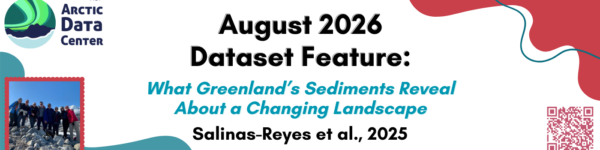
19 Minute Read From Florida to Greenland: The Researchers Behind the Science The Significance of Ice-loss to Landscapes in the Arctic (SILA) project began in 2020, but builds on an extensive history of collaboration among U.S. and Greenlandic scientists focused on understanding how landscapes, ecosystems, and water systems have changed following the loss of ice… Read more »
Blog & News Items
New Interactive Experiences in Portal Maps to Support Data Exploration at the Arctic Data Center
We’re excited to announce a new release of the Arctic Data Center’s software platform (Metacat UI 2.37.0), with powerful new ways to explore datasets and create richer data portal experiences. This release presents improvements to dataset version history, interactive mapping capabilities, and overall usability. Embedded Interactive Visualizations in Portal Maps Data portals are more valuable… Read more »
New Dataset Versioning Features to Support Reproducible Research
We’re excited to announce a new release of the Arctic Data Center’s software platform (Metacat UI 2.37.0), with powerful new ways to explore datasets and create richer data portal experiences. This release presents improvements to dataset version history, interactive mapping capabilities, and overall usability. Explore the Complete Version History of a Dataset Research datasets often… Read more »
What Arctic Phytoplankton Tell Us About a Changing Ocean
A Journey into Arctic Research Growing up, Dr. Clare Gaffey viewed the Arctic through a rose-colored lens: a vast, pristine landscape of white and blue ice, thriving ecosystems, and minimal human influence. Yet, her path into Arctic research was anything but direct. After earning a Bachelor’s degree in Environmental Science and a Master’s degree in… Read more »
NSF Reaffirms Commitment to Long-Term Preservation and Access of Arctic Research Data
In May 2026, the National Science Foundation (NSF) reaffirmed its commitment to Arctic research, data stewardship, and open science by awarding five additional years of funding for the Arctic Data Center. Led by the National Center for Ecological Analysis and Synthesis (NCEAS) at the University of California Santa Barbara, the Arctic Data Center has become… Read more »
What We Learned from the Arctic Data Center’s 2026 Community Survey
Over the past year, Arctic research has continued to evolve at a rapid pace, shaped by shifting environments, new technologies, and changing funding landscapes, along with growing expectations around data access, stewardship, and collaboration. As these pressures and opportunities converge, developing research infrastructure that can keep up with the evolving needs of the community it… Read more »
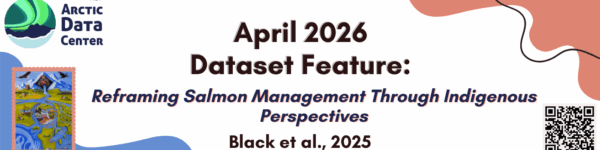
Reframing Salmon Management Through Indigenous Perspectives
Origins and Inspirations Dr. Jessica Black, of Gwich’in Dena heritage from the villages of Gwichyaa Zhee (Ft. Yukon) and Toghotthele (Nenana), Alaska, was motivated by her upbringing along the Yukon River to pursue her current work in academia. She observed how Indigenous people and their Knowledge systems were often marginalized in research and local governance… Read more »
Building Data Science Skills for Arctic Researchers: Recapping our 2026 Virtual Training Course
Training Overview Every spring, the Arctic Data Center invites Arctic researchers to attend our five-day virtual data science training course, Reproducible Approaches to Arctic Research Using R. This year, 18 researchers attended the course to learn reproducible and ethical research practices, methods for more easily documenting and preserving their data at the Arctic Data Center,… Read more »
March 2026 Collaborator Highlight: The Arctic Report Card
Background and Information Since 2006, the Arctic Report Card (ARC) has been an annual report led by the National Oceanic and Atmospheric Administration (NOAA) that informs the general public about recent environmental changes across the Arctic, from the sea ice, weather patterns, snow cover, and more. Each report includes a series of essays that break… Read more »
Listening to a Changing Arctic: Tracking Bowhead Whales Through Sound
Background and Research Expertise Dr. Angela Szesciorka is a Research Associate at the Pacific Northwest National Laboratory and a Faculty Affiliate at the Marine Mammal Institute at Oregon State University where she studies baleen whale ecology and movement. With a passion for writing, Szesciorka studied journalism for her undergraduate degree but went back to school… Read more »