
Background and Research Expertise
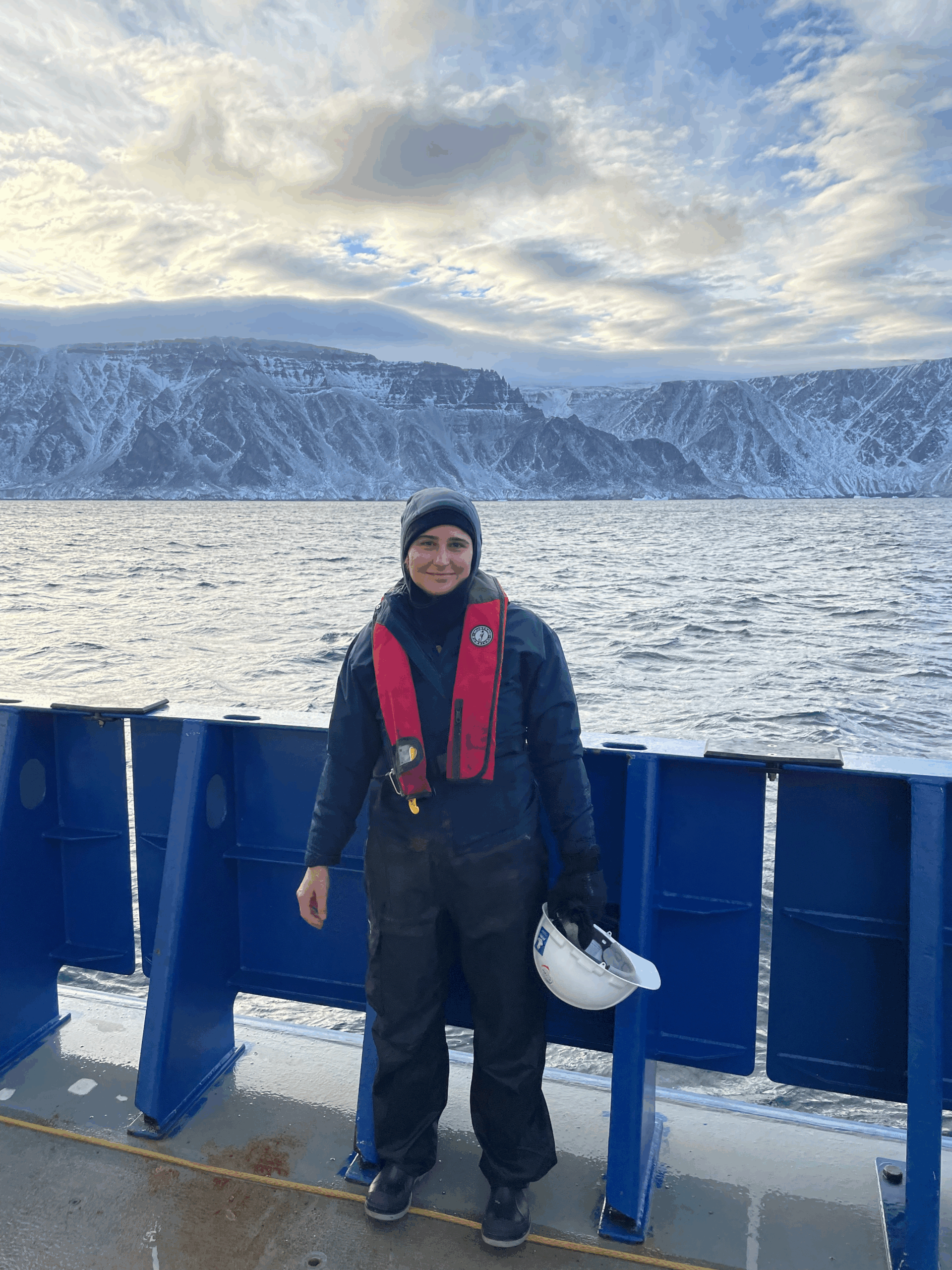
Photo of Angela Szesciorka.
Dr. Angela Szesciorka is a Research Associate at the Pacific Northwest National Laboratory and a Faculty Affiliate at the Marine Mammal Institute at Oregon State University where she studies baleen whale ecology and movement. With a passion for writing, Szesciorka studied journalism for her undergraduate degree but went back to school for ocean science at Moss Landing Marine Laboratories in Moss Landing, California when she realized her dream of becoming a marine biologist could be a reality. Her Master’s research exposed her to the world of whale research and she knew she’d found her passion.

Two bowhead whales surface in a small lead in April 2012. Photo by Kate Stafford.
She went on to pursue a PhD at Scripps Institution of Oceanography where she developed her approach for passive acoustic monitoring of blue whales and continued her research at Oregon State University through a polar postdoctoral fellowship funded by the National Science Foundation. Here, she worked with Dr. Kate Stafford who is one of the leading experts in bowhead whales in the Arctic. Szesciorka has now been studying whale ecology for over a decade.
Bowhead whales, as Szesciorka explains, are unique in that they’re endemic to the Arctic, can live up to 200 years, have massive heads that help them break through overlying ice to come up to breathe, and sing complex songs. She notes that similar to Tibetan monks, bowhead whales can produce two different tones at the same time, making their auditory patterns quite diverse and ethereal.
Dataset Highlight
Szesciorka explains that as the Arctic is changing faster than any other region on the planet, sea ice extent, volume, and age are all declining substantially. This and other large-scale environmental changes are altering the distribution and movement of Arctic marine mammal species. This led Szesciorka to ask: Is bowhead whale migration timing changing? Are their movement patterns across the Arctic changing? If so, how and why? She hypothesized that changes in whale behavior could be linked to changes in air temperature, sea ice, or prey movements, but also considered how humans could be impacting the species.

Spectrogram (visual representation of sound) of bowhead whale song from the Bering Strait recorded in January 2011. Time (sec) is displayed on the x-axis and frequency (kHz) is displayed on the y-axis. Graphic illustration by Angela Szesciorka.
Although Szesciorka began by going shipboard to tag whales, she realized the difficulty of this and moved to alternative methods such as passive acoustic monitoring or remotely-collected data. This method involves deploying hydrophones, which are underwater microphones, to record sound in the ocean with the goal of studying bowhead whale calls and songs. Hydrophones were deployed at three locations: just north of the Bering Strait, in the Chukchi Plateau, and in the western Beaufort Sea, encapsulating the bowhead whale migratory pattern, allowing her to track the timing of when they’re in these different areas. To extend the lifespan of the hydrophones, they are programmed to record at set intervals, reducing total recording time while still capturing representative data. She also emphasized the difficulty of analyzing the output of these hydrophones and is leading a separate project to determine if it’s possible to auto-identify bowhead whales in acoustic data. Currently, she looks at spectrograms to visually identify bowhead whale sounds to produce a timeseries of bowhead whale presence. This research resulted in the creation of the dataset published at the Arctic Data Center:
- Angela Szesciorka. (2025). Bowhead Whale Presence and Migration Timing in the Pacific Arctic 2008-2022. Arctic Data Center. doi:10.18739/A22Z12R6D.
As part of this same research, Szesciorka and colleagues have published two different papers on this work in Springer Nature Link and Geophysical Research Letters:
- Szesciorka, A. R., and Stafford, K. M. (2023). Sea ice directs changes in bowhead whale phenology through the Bering Strait. Movement Ecology, 11, 8. https://doi.org/10.1186/s40462-023-00374-5.
- Szesciorka, A. R., Stafford, K. M., and Berchok, C. L. (2024). Basin-wide shift in bowhead whale migration in the Pacific Arctic. Geophysical Research Letters, 51, e2023GL106416. https://doi.org/10.1029/2023GL106416.
Szesciorka explains that she also integrates environmental data to match with these acoustic recordings and gets her sea ice data from the National Snow and Ice Data Center, a frequent collaborator of the Arctic Data Center.

Single bowhead whale in young ice in April 2015. Photo by Kate Stafford.
Dataset Creation and Impact
Szesciorka was excited to make her data publicly accessible and ensured her data can be used by anyone by intentionally creating reproducible code throughout her project. While some researchers remain reluctant to openly share data, she’s hoping the climate continues to shift towards more open and collaborative practices. By making her data openly accessible, she hopes her data is used to answer more research questions and generate new insights that wouldn’t be possible in a siloed data landscape.
She is also hopeful that this dataset continues to grow over time and that the acoustic recordings, which record all sounds in the ocean, are used for other research questions outside of her project and continue to provide new information about the changing Arctic.
Unexpected Patterns in Bowhead Whale Migration

Schematic of changes to bowhead whale migration from earlier years (<2012) to later years (>2018) at migratory destinations throughout the western Arctic (Northwestern Bering Sea, Bering Strait, Chukchi Plateau, Western Beaufort Sea). Graphic illustration by Angela Szesciorka.
Szesciorka suspected a connection between bowhead whales and sea ice as their migration patterns moved more northward with more persistent sea ice. Each spring, bowhead whales typically migrate through the Bering Strait to feed on abundant zooplankton in the Chukchi and Beaufort Seas, yet their migration patterns began to change. Szesciorka observed that bowhead whales were spending more time north of the Bering Strait in the winter and in the summer, moving back and forth between the Canadian Beaufort Sea, where they usually feed, and the Chukchi Sea. This behavior suggested that feeding areas within the Chukchi Sea are becoming more favorable.
This unexpected behavior pattern was more apparent when pairing passive acoustic monitoring data with sea ice information. An analysis suggested the changing sea ice conditions, driven by a warming climate, were influencing where bowhead whales migrate, potentially driven by prey availability. While this change reflected the species’ adaptability to the changing environment, the long-term consequences of these changes are unknown.

Graphic depicting northward shift of bowhead whales with decreasing sea ice. Graphic illustration by Clarissa Teixeira.
Another unexpected outcome was that as bowhead whales changed their migration patterns, other whale species were doing the same. Although bowhead populations have recovered since commercial whaling was banned in the United States, they now face growing competition in Arctic waters. Humpback and minke whales, historically uncommon in the Arctic, are spending more time feeding in these waters. Passive acoustic monitoring data even reveal multiple whale species talking over each other in the waters, suggesting increased competition and overlap.
Additionally, killer whale predation on bowhead whales is increasing, which was rarely observed, and this new, growing concern requires more research. Szesciorka emphasized that understanding these dynamics will be critical for predicting the future of bowhead whales and the region and will also have important implications on Arctic Indigenous communities who rely on these marine mammals for subsistence.
Pursuing a Career in STEM

Photo of Angela Szesciorka.
Whether in the Arctic or elsewhere, pursuing a career in science can be challenging. Szesciorka emphasized the importance of taking any opportunities available to get your foot through the door. She suggested reaching out to researchers in your field of interest and asking to schedule a time to discuss their work. These informal conversations can be a low pressure way to gain more insight on a career path and build a meaningful connection. Volunteering is another pathway to help you explore and understand what particular species, field, or skill excites you most. Szesciorka also encourages students to apply for as many scholarships or funded research opportunities as possible, noting that enthusiasm and initiative are great qualities in emerging scientists.

Bowhead surfacing in a lead off Utqiaġvik, AK in April. Photo by Kate Stafford.
After spending approximately 175 days at sea, surrounded by marine mammals in the open ocean, Szesciorka deemed it one of the most rewarding experiences of her career thus far. She recalled an experience where hundreds of northern bottlenose whales surrounded their vessel in the Davis Strait near Greenland, and was fascinated by their level of curiosity. This kind of unique experience is what she loves most about getting out in the ocean. On a different expedition, she described an encounter in which humpback whales approached their boat in groups of two to three and lingered around for several hours. Szesciorka noted that they were able to record a wide range of acoustic sounds, revealing different and unexpected vocalizations from the whales.
How the Arctic Data Center Fosters Collaboration
The Arctic Data Center has served as a great tool for finding data and new collaborators for Szesciorka. She first used it to discover other Arctic researchers also studying bowhead whales, which led her to find one of her current collaborators. After discovering this group’s bowhead whale acoustic dataset, she recognized how valuable it would be to combine their research efforts. By integrating their data together, they were able to develop a deeper understanding into the drivers and implications of shifting bowhead whale migration patterns.
Written by Angie Garcia and Nicole Greco
Community Engagement and Outreach Coordinators